

When a printer fails in a New York, NY office, the financial clock starts immediately: proposals stall, shipping labels stop printing, and a backlog forms faster than anyone can clear it by hand. The right printer repairing service arrives within hours, carries the correct parts on the truck, and resolves the problem on the first visit.
ABC Computer Services has been keeping New York businesses operational for decades, from solo practices in Midtown to multi-department firms near Wall Street and warehouse operations across the outer boroughs. This guide covers what a professional printer repair visit actually looks like, how to compare providers on the metrics that matter, which failure types are most common in New York offices, and when a service contract outperforms break-fix billing.
Key Takeaways
- A guaranteed 4-hour response time is the benchmark that separates serious printer repairing services from those that schedule you for next week.
- A 95% first-visit fix rate is only possible when technicians arrive with pre-diagnosed parts, not just diagnostic tools.
- New York providers that service thermal label, line, dot-matrix, laser, and plotter printers cover far more business use cases than shops that handle only desktop models.
- Pickup and delivery repair is a legitimate alternative to onsite service when the printer is not mission-critical or when your office cannot accommodate a technician visit.
What a Printer Repairing Service in New York, NY Actually Delivers
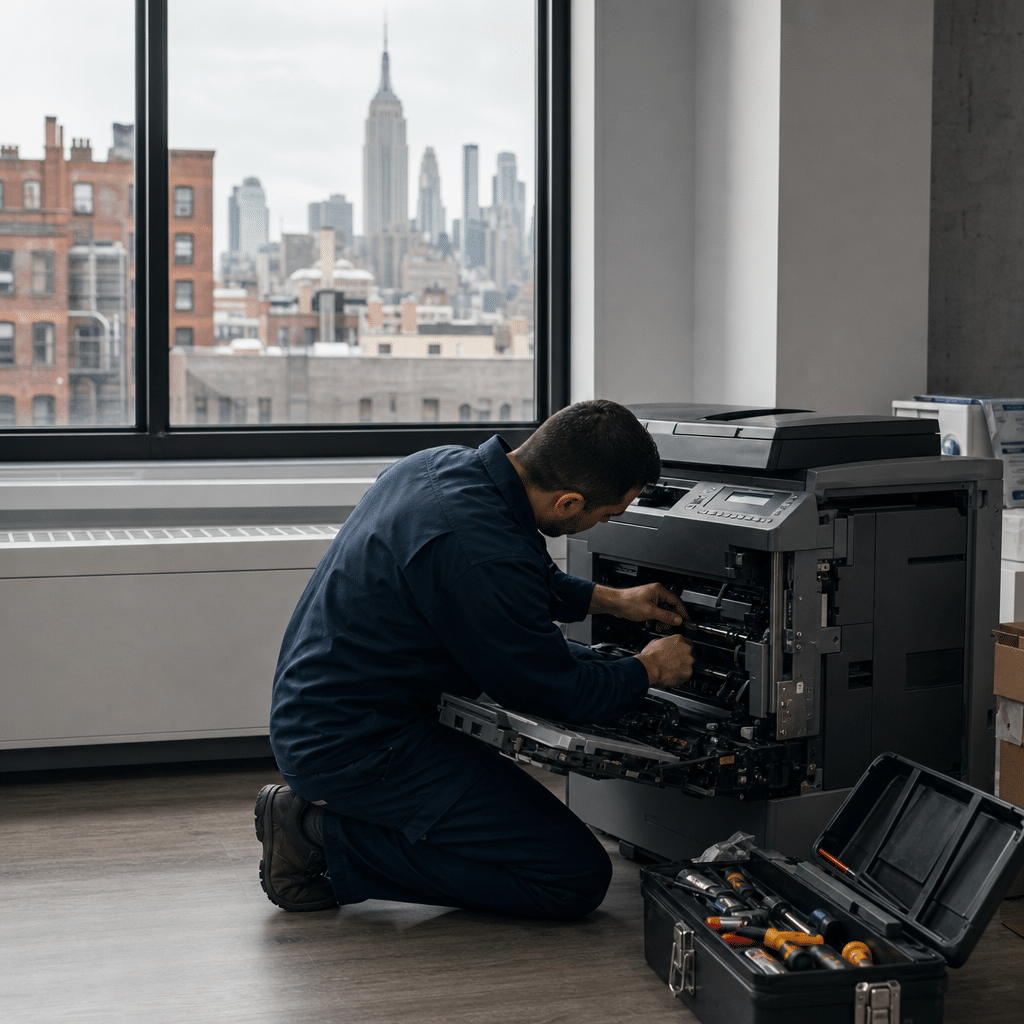
A professional printer repairing service in New York does far more than clear a visible jam or swap a toner cartridge. Certified technicians diagnose fuser assemblies, feed roller assemblies, drum units, formatter boards, and network interface cards, and a qualified provider resolves most of these failures in a single visit.
The difference between a real repair and a temporary patch comes down to parts quality and diagnostic depth. A technician who replaces only the component causing the immediate symptom without inspecting related wear items will almost always generate a callback within 30 days.
New York offices operate a wide mix of equipment: high-volume laser printers in accounting and legal departments, thermal label printers at shipping stations, wide-format plotters in architecture and engineering firms, and dot-matrix units still running multi-part forms in courts, warehouses, and healthcare facilities. A service provider worth retaining must be competent across all of these categories, not just the consumer-grade models that dominate online search results.
When you place a service call, the intake process matters as much as response speed. Sharing the exact model number, the current error code, and a clear symptom description allows dispatch to route the right technician with the right parts already loaded on the vehicle, which is what makes a 95% first-visit fix rate achievable.

The Most Common Printer Failures in New York Offices
Paper feed failures are the most frequently reported problem, and they almost always trace back to worn pickup rollers, a glazed separation pad, or paper stock that has absorbed humidity from a poorly ventilated supply room. Replacing the roller kit and cleaning the feed path resolves most of these cases in under an hour, assuming the technician carries the correct roller kit for that specific model.
Fuser failures produce wrinkled, smeared, or partially fused output and often trigger a hard stop with a specific error code on the control panel. Fusers are consumable components with documented page-count lifespans, typically between 150,000 and 300,000 pages depending on the make and model, so a technician who tracks maintenance history can often predict fuser replacement before a failure occurs.
Drum and imaging unit degradation shows up as repeating streaks, faded bands, or fixed-interval defects on the printed page. The interval between repeating marks is a precise diagnostic clue: it corresponds to the circumference of the drum, which narrows the failing component down quickly and avoids unnecessary parts replacement.
Network and driver issues have grown into a significant repair category as more New York offices rely on wireless, cloud-connected, or domain-joined print environments. A technician who understands both the hardware layer and the network configuration can resolve connectivity problems that a hardware-only shop would misdiagnose as a firmware failure, saving an unnecessary follow-up visit.
Onsite vs. Pickup-and-Delivery: Choosing the Right Service Format
Onsite repair is the fastest path back to full operation for any printer that sits at the center of a team’s daily workflow. The technician comes to your Manhattan, Brooklyn, Queens, Bronx, or Staten Island location, diagnoses the machine in its actual environment, and completes the repair without you having to disconnect cables or transport a heavy unit through a busy lobby.
Pickup and delivery repair works well when the affected printer is not mission-critical or when your office schedule allows a 24-to-48-hour downtime window. The provider collects the unit, completes the repair at the depot facility, and returns it, which is often the most practical option for smaller desktop printers in dense Midtown offices where space for an onsite visit is limited.
For high-volume production printers, laser multifunction units with paper towers, or wide-format plotters that weigh several hundred pounds, onsite service is the only practical option because the logistics of transport would add cost and risk without any benefit. For thermal label printers, smaller laser desktops, or portable units, depot repair via pickup frequently delivers a faster turnaround at a lower labor rate.
ABC Computer Services offers both onsite and pickup-and-delivery options so the choice is driven by your workflow priority rather than the provider’s convenience. Matching the service format to the actual criticality of the machine prevents both overspending on emergency onsite rates for non-critical devices and under-responding when speed genuinely matters to your operation.
How to Compare Printer Repair Providers in New York, NY
Response time is the first metric to verify, and the word ‘guaranteed’ carries real weight. A provider advertising a 4-hour response window that buries exceptions in fine print is a different product from one that holds that standard across all five boroughs and the surrounding metro area, so ask directly how the guarantee applies to your specific address before signing anything.
First-visit fix rate is equally important and harder to fake over time. Achieving a 95% first-visit fix rate requires pre-call triage that identifies the likely failure before dispatch, vehicles stocked with the parts that match those failure patterns, and technicians who know the model-specific quirks of the machines they are sent to repair.
Brand certifications confirm that a technician has been trained and tested by the manufacturer rather than working from general mechanical experience. Factory-authorized status for HP, Canon, Lexmark, Ricoh, or Zebra means access to OEM replacement parts, official service documentation, and manufacturer-backed technical support lines that independent shops cannot reach.
Supported printer categories reveal the true scope of a provider’s capability and matter more than most businesses realize until they have a gap in coverage. A shop that handles only laser printers will leave your thermal label station, your dot-matrix legacy system, or your wide-format plotter without a qualified technician, forcing you to manage multiple vendor relationships and multiple response-time commitments.
Service Contracts vs. Break-Fix Billing: Costs and Trade-Offs
Break-fix billing means you pay per incident with no ongoing commitment, which suits businesses that operate one or two low-volume printers where failures are rare and the annual cost of a contract would exceed the total cost of occasional repairs. The trade-off is that contract customers typically receive priority scheduling, while break-fix callers are queued behind them during busy periods.
A service contract makes clear financial sense when you run multiple machines, print at high monthly volumes, or operate a workflow where unplanned downtime carries a direct revenue cost. Contracts typically include preventive maintenance visits that catch roller wear, fuser age, lubrication deficiencies, and paper path debris before they cause a hard failure.
Preventive maintenance under a contract extends machine life in a way that matters specifically in New York, where replacing a mid-range laser printer means not just the equipment cost but also the logistics of delivery to a high-rise building with a restricted loading dock schedule. Keeping a reliable machine running for an additional two or three years through proactive service is often the smarter financial decision when replacement cost and logistics are factored in together.
When comparing contract pricing, examine the per-visit labor rate, whether parts are included or billed at retail on top of the contract fee, and whether consumables such as fuser units and roller kits are bundled or excluded. A contract priced lower up front but billing parts separately can cost more annually than a higher-tier plan that bundles everything into a predictable monthly figure.
Printer Types Serviced: What a Full-Coverage New York Provider Handles
Laser printers dominate New York offices because of their speed, low per-page cost, and reliability at high volumes, but they also carry the most complex internal assemblies of any desktop category. Fuser units, drum cartridges, transfer belts, and multi-stage paper path rollers all require model-specific training to diagnose and replace correctly, which is why factory certification matters more for this category than any other.
Thermal label printers are critical infrastructure in e-commerce fulfillment operations, medical facilities printing patient wristbands and specimen labels, and any business processing shipping labels at volume across Zebra, Datamax, or Honeywell platforms. Print head failures, platen roller wear, and calibration drift are the dominant failure modes, and finding a New York service provider who stocks thermal print head assemblies for these brands is far less common than finding general laser repair.
Dot-matrix printers remain active in legal offices, government agencies, and industrial facilities where multi-part carbon forms require impact printing that no laser or inkjet can replicate. Locating a New York repair provider who carries dot-matrix print head assemblies, platen gap adjustment tools, and ribbon drive components is significantly harder than finding laser support, so verifying coverage before you need it avoids a crisis search.
Wide-format plotters serve architecture firms, engineering consultancies, and marketing agencies that print large-format drawings, technical diagrams, and display graphics. These machines require specialized knowledge of media handling systems, printhead array maintenance, capping station cleaning cycles, and encoder strip calibration that falls entirely outside the skill set of a standard laser printer technician.
Frequently Asked Questions
What is the fastest way to get a printer repairing service in New York, NY?
Call a provider that guarantees a 4-hour onsite response time and performs phone triage before dispatch so the technician arrives with the correct parts already on the truck. ABC Computer Services covers Manhattan and the surrounding boroughs with same-day service, and calls placed before early afternoon typically result in a same-business-day repair.
How much does printer repair cost in New York?
Onsite break-fix visits for common repairs such as roller replacements or fuser swaps typically range from $100 to $300 in New York, with parts billed separately unless covered by a service contract. Complex repairs involving formatter boards, thermal print heads, or wide-format plotter components can run higher, so asking for a written estimate before authorizing work protects your budget and avoids surprises.
Can a technician repair my printer at my office in New York City?
Yes, onsite printer repair is available across all five boroughs including Manhattan, Brooklyn, Queens, the Bronx, and Staten Island. Technicians arrive with diagnostic tools and a stocked inventory of common replacement parts, which is what makes a 95% first-visit resolution rate possible rather than requiring a parts-order follow-up.
What printer brands do New York repair services typically support?
Established providers in New York generally service HP, Canon, Lexmark, Ricoh, Brother, Epson, Zebra, and Xerox, with factory-authorized shops having direct access to OEM parts and manufacturer technical support for those specific brands. Confirming factory certification for your brand before scheduling gives you confidence that the technician has model-specific training, not just general repair experience.
Is pickup and delivery printer repair available in New York, NY?
Yes, several New York printer repair providers offer pickup and delivery as a structured alternative to onsite visits, with most depot turnaround times running 24 to 48 hours. This option works particularly well for smaller or non-critical printers where same-day restoration is not required, and it often carries a lower labor rate than an emergency onsite dispatch.
What does a 95% first-visit fix rate actually mean for my business?
It means the technician resolves the problem completely on the initial visit without requiring a return trip for additional parts or follow-up diagnosis 95 percent of the time. Reaching that rate in practice requires accurate pre-call symptom triage, service vehicles stocked with the parts that match the most common failure modes for the models in service, and technicians who have logged enough hours on those specific machines to diagnose accurately under time pressure.