

When a copier fails in a Manhattan office first thing Monday morning, deadlines for closings, claims, and client deliverables freeze along with it. The right repair partner shows up the same business day with the right parts already on the truck and a technician who already knows your model.
ABC Computer Services has repaired office equipment across Manhattan, Queens, Brooklyn, and the rest of New York City for more than 30 years. This guide walks through what professional copier repair in Manhattan should actually look like, what common failures cost in time and parts, and how to vet a service partner before you sign anything.
Key Takeaways
- Most Manhattan copier failures cluster into five buckets: paper path jams, fuser wear, drum or imaging unit faults, scanner faults, and network or driver problems.
- Same-day on-site response in Manhattan turns a half-day outage into a one-hour interruption, especially in midtown towers with strict freight elevator windows.
- A stocked service vehicle carrying fusers, rollers, drums, belts, and waste toner bottles is what separates a real repair from a diagnostic visit followed by a second trip.
- Preventive maintenance contracts cut emergency calls by roughly half compared with break-fix only, and they lock in flat per-page pricing for parts, labor, and toner.
Why Manhattan Offices Cannot Afford Copier Downtime
Manhattan offices run on tight cycles: closing dockets at law firms, claims packages at insurance brokers, and patient charts at medical practices along the East Side hospital corridor. When the copier fails first thing Monday morning, a single jam can stall a billable team of 12 people for the rest of the day.
Building access compounds the problem in this borough more than almost anywhere else. A technician without a current certificate of insurance on file, or one who shows up outside the freight elevator window at 1290 Avenue of the Americas, gets turned away at the loading dock and the call slides into tomorrow.
That is why the response timer for Manhattan copier repair really starts long before the truck rolls. The dispatcher has to know your building rules, your floor, and your machine model before the call is even routed to a technician with the right parts.
A two-hour outage at a busy midtown firm can easily translate into thousands of dollars of stalled labor, missed billable hours, and slipped client deliverables. The math is what makes professional response, not generalist service, the only sensible option for any production copier in this market.
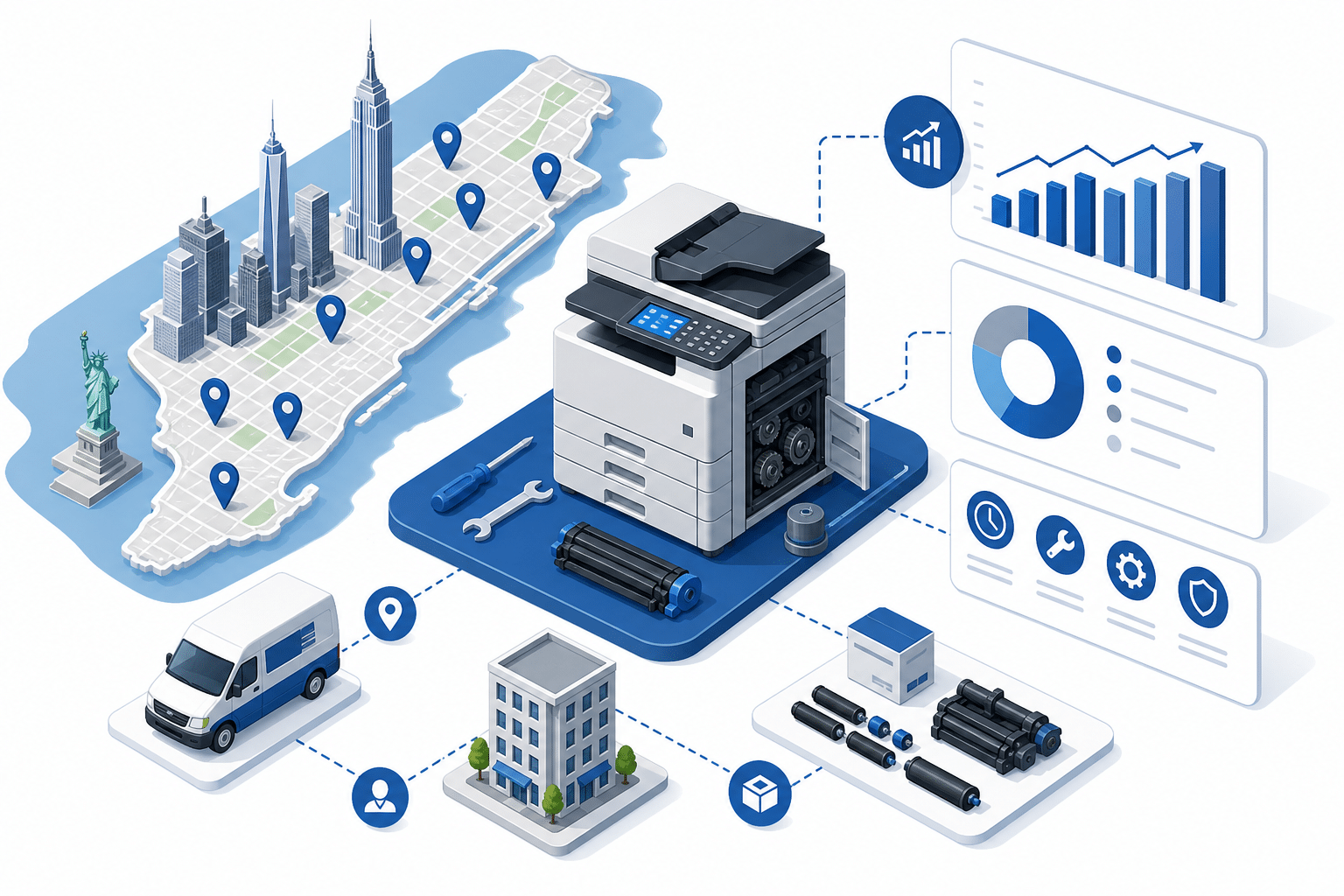
Manhattan Copier Repair: Service Types, Pricing Ranges, Turnaround, and Warranty
Pricing ranges reflect typical service rates for office class multifunction printers in Manhattan and are confirmed in writing before any work is authorized.
The Most Common Copier Failures We See in New York Offices
Paper path jams remain the number one service call across New York offices, especially in older buildings with limited HVAC control. The fix is almost always a worn pickup roller, a torn separation pad, or paper that has absorbed humidity in a stockroom located too close to the building riser.
Fuser problems show up as wrinkled output, ghosted images, or a hard-stop error code on the control panel. Fusers are wear items rated between 150,000 and 300,000 pages depending on make and model, and they almost always throw a visible warning sign before the unit bricks itself entirely.
Drum and imaging unit wear is the third bucket and the one that surprises clients the most. You will see streaks, repeating spots at a fixed interval, or banding that no toner swap will fix, which means the drum has reached end of life and needs replacement.
Scanner faults and network problems round out the list and frequently get misdiagnosed. A single failed LDAP binding, a stuck ADF roller, or a routing change at your IT firewall can stop scan-to-email cold, and those calls routinely get blamed on the copier when the root cause is elsewhere on the network.
What Same-Day Copier Service in Manhattan Actually Requires
Same-day service in Manhattan is a logistics problem before it is ever a technical one. The provider needs a tight triage process, a parts-stocked vehicle, and a dispatcher who routes calls by skill set and parts inventory rather than by who is closest on a map.
Expect to be asked for the model number, the panel error code, the specific symptom, and the building address with floor and suite numbers. That information lets dispatch confirm the right parts are already on the truck before the technician is ever en route to the building.
Travel inside Manhattan is its own challenge that outsiders consistently underestimate. A drive of about a mile and a quarter from a 23rd Street office to a 42nd Street office can take 35 minutes during the morning rush, so providers that pre-position technicians in midtown have a real advantage over those dispatching from outer-borough yards.
Stocking matters more than miles when the clock starts. A technician without the right fuser, feed roller, drum, or waste toner bottle on board is essentially performing an inspection visit rather than a repair, and the second trip is the one that actually costs you the rest of the day.
Brands and Models We Repair Across New York Offices
ABC Computer Services repairs Canon imageRUNNER, Konica Minolta bizhub, Ricoh IM and MP series, HP LaserJet and PageWide, Sharp MX, and Toshiba e-STUDIO multifunction printers as standard work. Legacy machines from Kyocera, Xerox WorkCentre, and Lexmark are handled by special arrangement when replacement parts are still in production from the manufacturer.
Our technicians carry current manufacturer training certificates for each of the major lines and renew them on the release cycle for that brand. That matters when a 2024 bizhub firmware update quietly changes the fuser thermistor profile and a 2019 service playbook will brick the unit on the next power cycle.
Production class units like the Canon imagePRESS, Ricoh Pro, and Konica AccurioPress get a separate roster of trained technicians because the duty cycle, registration tolerances, and finisher complexity are not comparable to office multifunction printers. We do not pretend a standard office tech can service a 6,000 sheet per hour production press at the same speed.
If your model is outside our roster, we will tell you that on the very first call. We would rather refer you to a brand-authorized shop than collect a deposit on a job we cannot finish properly the first time out.
Service Contracts vs Break-Fix Repair in Manhattan
Break-fix billing makes sense for offices with one low-volume machine and a flexible workflow that can absorb a day of downtime. You pay per visit, per part, and per labor hour, and you accept the wait when a technician is not immediately available in your neighborhood.
Service contracts shift the math the moment the copier becomes mission critical. A typical Manhattan agreement bundles preventive maintenance, parts, labor, and toner into a flat per-page cost, with black and white pricing usually quoted in fractions of a cent and color pricing landing between four and nine cents per page depending on monthly volume.
Preventive visits cut emergency calls roughly in half across our Manhattan book of business. That single metric tends to justify the contract for any office printing more than 5,000 pages a month or running a single production-class machine that the rest of the office depends on.
Contracts also lock in response windows in writing rather than as a verbal promise on a sales call. A 2 hour or 4 hour response tier inside a signed agreement is a different commitment than a friendly assurance over the phone from someone who is not the dispatcher.
How to Prepare Your Office for a Faster Service Call
Three pieces of information shave 20 to 40 minutes off every service call before the technician even arrives. The model number, the panel error code, and a clear photo of the failed output should already be in the ticket before the technician leaves the shop.
Keep a simple service log next to the machine and use it consistently. A one page sheet that tracks toner swaps, jam locations, paper brands, humidity issues, and error codes will surface patterns that no single visit can diagnose on its own.
Confirm building access rules with your office manager in advance of any service call. Most Manhattan buildings require a current certificate of insurance on file with the management company, photo ID at the lobby desk, and a freight elevator booking for any service expected to run longer than 30 minutes.
Designate one point of contact in your office for copier service calls and stick with it. The receptionist often handles the building escort, but the actual machine knowledge usually lives with an office administrator or operations lead, and that person should be the one we reach during dispatch.
Warranty Coverage and What It Actually Pays For
Most new copier sales include a one year manufacturer warranty on parts and labor, with consumables like toner, drums, and fusers specifically excluded. Read the page count cap carefully because many manufacturer warranties void coverage past a printed page threshold that production offices will hit inside six to nine months of normal use.
Our completed repair work carries a 90 day labor warranty and a parts warranty that matches the manufacturer original, whichever is longer in your specific case. If the same component fails for the same reason within that window, the return visit is no charge to you at all.
Out of warranty machines are still very serviceable across Manhattan and most of New York City. A 5 year old Ricoh IM C3500 with 250,000 pages on the meter has plenty of working life left when the fuser, drums, and feed rollers are refreshed on a documented preventive schedule.
Extended service plans purchased separately from the original sale are not a substitute for proper preventive maintenance. They usually cover the same parts you would replace anyway, just on a different billing schedule, so weigh the premium against a maintenance line item inside a real service contract.
Coverage Across Manhattan and the Surrounding New York City Boroughs
Our service map covers all of Manhattan, from the Financial District up through Harlem, with regular daily routes through midtown east, midtown west, and the Upper East and West Sides. Same-day response extends into Queens, Brooklyn, and the Bronx on most business days, with Staten Island handled on a scheduled basis when volume supports it.
Buildings we work in routinely include single tenant brownstones, prewar office co-ops, and modern Class A towers with strict freight elevator policies. Each has its own paperwork and access rules, and our dispatch team keeps the requirements on file so your office manager does not have to chase them every visit.
Out of borough offices with a Manhattan headquarters can be served under a single unified contract. That keeps reporting, billing, response standards, and preventive maintenance schedules uniform across all of your New York City locations.
We staff dedicated routes for Lower Manhattan, midtown, and uptown so the same technician tends to see your machine repeatedly over time. That continuity catches early stage component wear that a rotating technician would routinely miss on a first visit to an unfamiliar device.
Frequently Asked Questions
How fast can you respond to a copier service call in Manhattan?
For contract clients in Manhattan, our standard on-site response window is 4 hours from call to arrival, with a 2 hour window available on premium contracts. Break-fix calls placed before midday on a business day are typically handled the same business day, subject to building access and parts availability on the truck.
Which copier brands do you service across New York?
We service Canon, Konica Minolta, Ricoh, HP, Sharp, and Toshiba multifunction printers across Manhattan and the rest of New York City as standard work. Legacy units from Kyocera, Xerox WorkCentre, and Lexmark are handled by special arrangement when replacement parts are still available from the manufacturer or aftermarket.
What does a typical copier repair cost in Manhattan?
Diagnostic visits generally run between $125 and $225, and full repairs typically land between $250 and $850 depending on the failed component. Major assemblies like a color fuser or imaging unit can push the total higher, which is why we always quote in writing before authorizing the work.
Do you offer service contracts with guaranteed response times?
Yes, our Manhattan service contracts include 4 hour and 2 hour response tiers, scheduled preventive maintenance visits, parts, labor, and toner. Pricing is set per printed page so your monthly invoice scales naturally with actual usage rather than a flat rate that punishes light months.
Is it worth repairing a copier that is more than 5 years old?
Often yes, especially for machines rated for 300,000 pages or more that have been maintained on a regular schedule. We will pull the page count and full service history during the diagnostic and tell you straight whether a repair beats a replacement on total cost of ownership.
Do you service production class machines and finishers?
Yes, we maintain a separate roster of technicians trained on Canon imagePRESS, Ricoh Pro, and Konica AccurioPress production units along with their booklet, staple, and folding finishers. Production work is dispatched under a different SLA because parts inventory and skill set requirements are not the same as standard office multifunction repair.
Businesses that need a single vendor to Repair Office Equipment across printers, copiers, and fax machines can consolidate service under one contract.
Modern copiers store job logs, network credentials, and scanned documents on internal hard drives, so Addressing Security Concerns In Printing is an essential part of protecting your office data alongside physical repairs and maintenance.
Before committing to any service agreement, review What To Do Before Signing A Contract to understand the key terms, response guarantees, and pricing structures that should be confirmed in writing.