

When a Canon imageRUNNER goes down at a Midtown firm, the impact is immediate: queued invoices, stalled closings, and a line forming at the front desk. The fix has to be quick, the technician needs to know the model, and the right parts need to be on the truck before the call even ends.
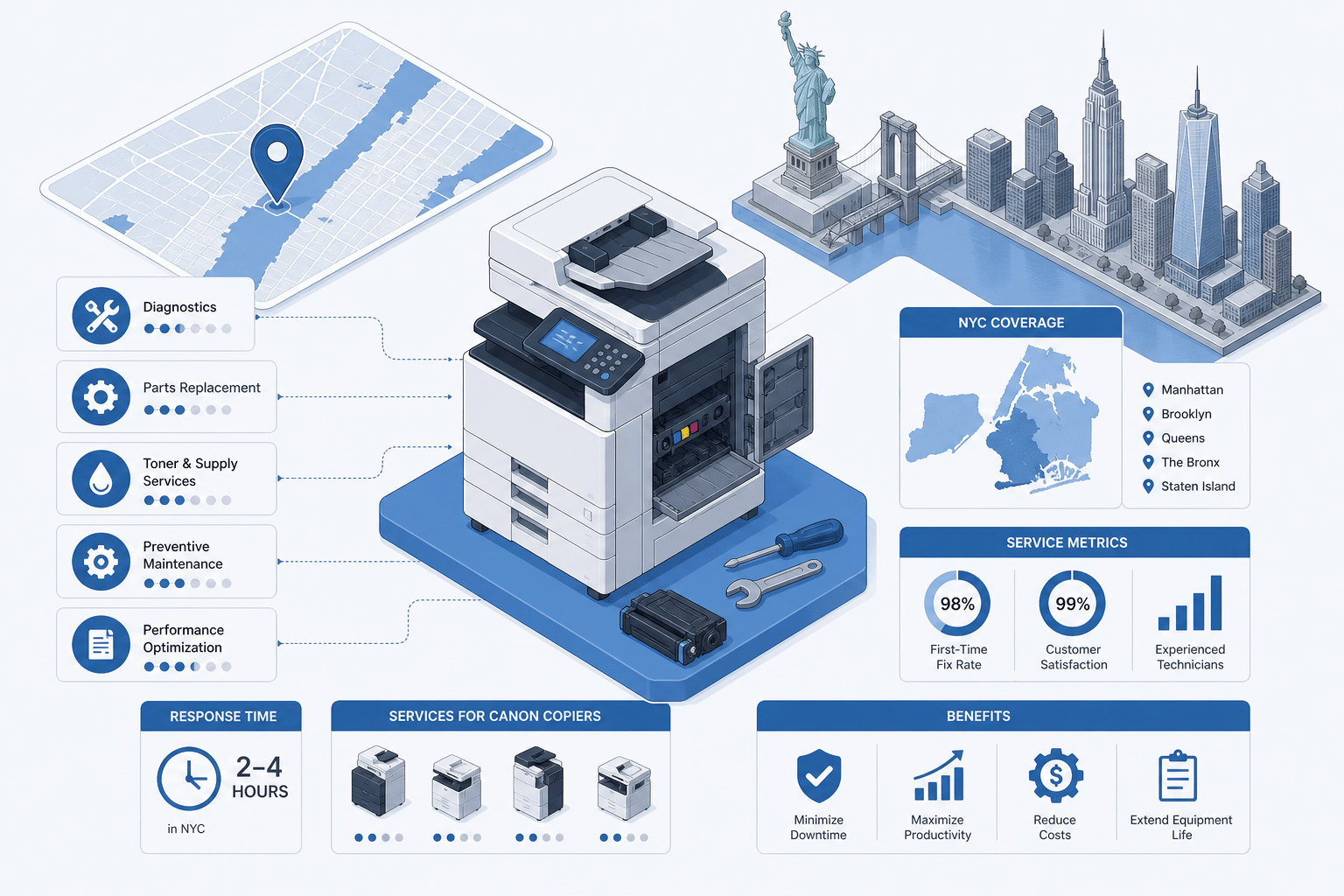
ABC Computer Services has supported Canon copiers across New York City for more than 30 years, covering Manhattan, Brooklyn, Queens, the Bronx, and Staten Island. This guide walks through the Canon failures we see most often in NYC offices, what they actually cost to repair, and how to decide when it makes more sense to replace the machine instead.
Key Takeaways
- Most Canon failures in NYC offices fall into five buckets: paper path jams, fuser and fixing film faults, drum or developer wear, scanner and ADF issues, and network or driver problems.
- Parts pricing varies widely by model. A drum unit may run $119 to $300 on older imageRUNNER units, while a color fuser assembly on an imageRUNNER ADVANCE can land between $450 and $900 installed.
- The 50 percent rule is the cleanest first cut for repair vs replace. If a single repair exceeds half the cost of a comparable new Canon, replacement deserves a serious look.
- OEM parts availability tightens fast after a Canon model is discontinued, because manufacturers are only required to keep parts in production for roughly seven years past that date.
Why NYC Offices Cannot Afford Canon Copier Downtime
Canon copiers anchor the document workflow at thousands of NYC offices, from law firms in the Financial District and medical practices on the Upper East Side to accounting groups in Midtown and design studios in DUMBO. When an imageRUNNER goes down on a Tuesday morning, billing stops, closings slip, patient intake backs up, and the receptionist starts apologizing to anyone standing at the counter with a stack of paperwork.
The real cost of that downtime in New York is almost never the replacement part itself. It is the billable hour the partner cannot record, the courier rebooked because the lease was not signed in time, the patient who reschedules because intake forms could not be printed, and the hourly staff watching the front desk instead of working their queues.
That arithmetic is why fast, on-site Canon service matters more in NYC than in most markets in the country. A copier sitting idle for two days in a Midtown firm is not a minor inconvenience, it is a measurable hit to revenue, client trust, and team morale.
The Most Common Canon Repairs We See in New York Offices
Paper path jams account for the majority of service calls we run on Canon imageRUNNER ADVANCE, imageCLASS, and DX-series MFPs across NYC. They almost always trace back to worn pickup or feed rollers, a tired separation pad, a slipping registration clutch, or paper that has absorbed too much humidity in a stockroom near a steam radiator or HVAC return.
Fuser and fixing film failures are the second most common category, and they typically announce themselves through Canon E-codes. E000 to E004 codes are critical fuser temperature errors, whether it is a failed thermistor or a torn fuser film, while E007 film errors indicate the fuser belt has slipped or torn and a full assembly swap is needed.
Drum, developer, and intermediate transfer belt wear show up as streaks down the page, faded margins, color registration drift, or repeating defects every few inches. Replacing wear components like drum units and fuser assemblies is a cost-effective way to extend the service life of Canon hardware, and these parts have published page-count life counters rather than random failure curves.
Scanner board faults, ADF (automatic document feeder) feed jams, and network or driver glitches round out the top five categories. Driver issues are easy to misdiagnose because they often surface right after a Windows or macOS update, look like a hardware problem, and ultimately need a software fix rather than a parts call.
Canon Repair Cost Ranges by Model Family
Cost ranges vary widely across the Canon lineup, so any quote without a specific model number is essentially a guess. An imageCLASS MF series fuser repair sits in a very different price bracket from an imageRUNNER ADVANCE DX color unit, even when the customer-facing symptom looks identical at the control panel.
On older monochrome imageRUNNER units (the iR 2000, 3000, and 4000 series), a drum unit typically runs around $119 to $180 in parts, with the drum assembly priced higher at roughly $165 and up, and installation labor usually adds $125 to $200 depending on dispatch time. A fuser assembly on the same families lands between $250 and $500 installed, and a pickup roller kit usually comes in well under $200.
Color imageRUNNER ADVANCE and DX-series machines carry pricier consumables because the assemblies are larger and the toner paths more complex. A full color fuser swap on a C3500 or C5500 series runs $450 to $900 installed, and an intermediate transfer belt replacement often lands in the $350 to $700 range, parts and labor combined.
A network, driver, or configuration call that does not require parts is usually the cheapest visit on the menu. Expect $125 to $250 for an on-site fix in NYC, depending on dispatch window, borough, and the complexity of the workflow involved (scan-to-folder, SMB authentication, and follow-me print setups all add time to the visit).

Parts Availability and the Seven-Year Cliff
Canon, like the rest of the office equipment industry, generally only keeps parts in production for a limited window after a model is discontinued. When copiers and printers surpass roughly the 7-year age mark, parts become scarce because manufacturers are only required to make parts for 7 years from the discontinued date of production.
For an NYC office still running an iR 2270, an iR 3300, an early imageRUNNER ADVANCE C5235, or a similar legacy color unit, that cliff has either already arrived or is uncomfortably close. Aftermarket and remanufactured parts can absolutely keep these machines productive, but lead times stretch from same-week to multi-week, and certain low-volume SKUs simply stop showing up in any catalog at all.
The practical implication is straightforward: once a Canon model crosses the seven-year mark and OEM stock thins out, every repair carries a higher risk of a back-ordered component and a longer downtime window. That is the moment a service partner should be running an honest repair-or-replace conversation with you, not surprising you on the third visit with a part that is six weeks out from the warehouse.
Repair vs Service Contract vs Replace: How the Scorecard Works
Three numbers drive a clean repair-or-replace decision on any Canon copier: the cost of the proposed repair, the price of an equivalent new unit, and the lifetime page count on the current machine. Run each number against a simple threshold and the right answer usually surfaces in minutes, without guesswork or vendor bias.
The 50 percent rule is the first cut, and it has been the industry standard for years. As a general rule, if the cost of repairing the copier exceeds 50 percent of the price of a new one, replacement should be seriously considered, and older machines also tend to require more frequent part replacements that add up quickly.
The lifetime volume test is the second cut, and it tends to be more accurate than calendar age alone. A good rule of thumb is to multiply the recommended monthly volume by 84, which represents twelve months a year for seven years, and if your device’s page count is higher than that number, replacement may be your best bet.
A service contract sits between break-fix repair and outright replacement for the right kind of office. A managed plan provides regular maintenance that catches potential issues before they escalate into costly repairs, helps businesses predict their printing costs by converting variable expenses into fixed costs, and offers expert support from technicians well-versed in your specific printer models, which is exactly what an NYC office needs when minutes count.
What Same-Day Canon Service Looks Like in NYC
Same-day Canon service across NYC is a logistics problem before it is a technical one. Traffic between Midtown and Long Island City, parking in the Garment District, freight elevator scheduling in Hudson Yards, and building security check-in at One World Trade all eat clock time that the technician can never get back.
Real same-day service requires three things working together: a dispatcher who triages calls by symptom and model rather than by call order, a technician trained on the specific imageRUNNER or imageCLASS family in the field, and a truck stocked with the SKUs that match the failures we see most often. Sending whoever is geographically closest, without those three pieces in place, mostly produces inspection visits dressed up as repair calls.
When you call ABC, expect a question or two about the model number, the displayed error code, the recent maintenance history, and the address details for elevator and dock access. That two-minute triage on the phone is what lets us route the right technician with the right parts on the first visit, instead of the second or third.
Preventive Maintenance That Cuts Canon Repair Frequency
Most Canon failures we run in NYC are not surprises, they are missed maintenance intervals catching up with the machine. Pickup rollers, separation pads, fuser cleaning webs, and transfer belt cleaners all have documented service intervals that Canon publishes per model, and ignoring them turns predictable wear into unscheduled downtime.
A scheduled preventive maintenance visit catches the wear before it becomes a service call. We pull the page count, compare it to the model’s PM schedule, replace the components that are at or near end of life, update firmware, and document the visit so the next technician inherits a clean history.
Offices that run a quarterly or semiannual PM on their Canon fleet typically see emergency call frequency drop by 40 to 60 percent year over year. The math is simple: a planned 90-minute visit is always cheaper than an unplanned all-day outage on a Monday morning when payroll has to run.
How to Choose a Canon Service Partner in NYC
The NYC market has dozens of copier service providers, and the gap between the best and the worst is wider than most office managers realize. A handful of pointed questions on the first call will sort the field quickly and protect you from the wrong fit before a contract is ever signed.
Ask which Canon model families they actively service, how many of those SKUs they stock on the truck, and what their average parts-on-first-visit rate runs. Vendors who hedge on any of those three answers are usually telling you they sub the work out, order parts after the visit, or do not actually track first-visit completion at all.
Also ask for response time commitments in writing, not just in conversation. A contract that names a 4-hour response window with documented escalation paths is meaningfully different from a vague promise to come out same day, and it is the only version that holds up when a real outage hits.
Frequently Asked Questions
How fast can ABC respond to a Canon copier service call in NYC?
For service contract clients in Manhattan and the outer boroughs, our standard response window is 4 hours from call to on-site. For break-fix calls we target same business day when the request comes in before 1 p.m., and next business day when it comes in later than that.
Do you stock Canon parts on the truck, or order them after the visit?
Our trucks carry 100 plus Canon SKUs covering the most common imageRUNNER and imageCLASS failures: fuser assemblies, pickup rollers, separation pads, drum units, and transfer belts for the model families we see most across NYC. Special-order parts on older or low-volume models can still take 1 to 3 business days, but everyday repairs are first-visit fixes the vast majority of the time.
Can you still service older Canon imageRUNNER models past the 7-year parts window?
Yes, in most cases. We keep remanufactured fuser assemblies and aftermarket drum units for legacy Canon models like the iR 2270, iR 3300, and early imageRUNNER ADVANCE color units, and we will tell you up front when a specific repair is realistic and when replacement is the more honest answer.
When does it make sense to replace a Canon copier instead of repairing it?
The two clearest signals are a single repair quote that exceeds 50 percent of a comparable new unit, and a lifetime page count higher than the recommended monthly volume multiplied by 84. Frequent repeat repairs inside a 90-day window are the third signal, because the cost of downtime in a busy NYC office tends to dwarf the cost of any individual fix on the invoice.