

When a barcode scanner goes down in a New York warehouse, retail store, or hospital receiving dock, every transaction that depends on it stalls within minutes. Getting the right technician on-site fast, with the correct parts already in hand, is the difference between a one-hour interruption and a day of manual workarounds.
ABC has been servicing barcode scanners and related data-capture hardware across New York City for years, supporting operations in retail, logistics, healthcare, and manufacturing. This guide covers the most common failure points, what a solid maintenance plan actually includes, and how to evaluate a repair partner before your next scanner goes down.
Key Takeaways
- Most barcode scanner failures in New York businesses trace to four root causes: physical drop damage, worn or cracked scan windows, cable and connector failures, and firmware or decoder errors that require bench-level diagnostics.
- Preventive maintenance contracts that include cleaning cycles, firmware updates, and annual hardware inspections can cut unplanned downtime by roughly 40 to 60 percent compared to a break-fix-only approach.
- Response time matters more than price in high-volume New York operations. A technician without the correct replacement window, cable harness, or decode board is just an inspection visit, not a finished repair.
- Mixing scanner models across a single New York facility creates hidden maintenance costs. Standardizing on one or two supported platforms lowers parts inventory, training time, and average repair turnaround.
Why New York Businesses Rely on Professional Barcode Scanner Repair
New York operates at a pace where a non-functional scanner is not just an inconvenience. It is a bottleneck that backs up receiving lines, delays patient medication verification, or freezes a point-of-sale queue during peak hours.
Professional repair services bring two advantages that self-service or mail-in depot repair cannot match: local response speed and model-specific expertise. A technician who has opened the same Honeywell, Zebra, or Datalogic model dozens of times diagnoses the fault faster and avoids mishandling sensitive decoder optics.
New York’s density of industries that depend on barcode scanning – food distribution, retail, healthcare, hospitality, and manufacturing – means the local repair ecosystem is more developed here than in most other U.S. market s. That works in your favor when you need a part sourced quickly or a loaner unit arranged while a repair is in progres
s.
Choosing a repair partner with a physical presence in New York also matters for warranty paperwork and OEM-authorized service paths. Some manufacturers require a local authorized technician to keep depot warranty claims valid, and that requirement catches businesses off guard when they use out-of-state mail-in services.
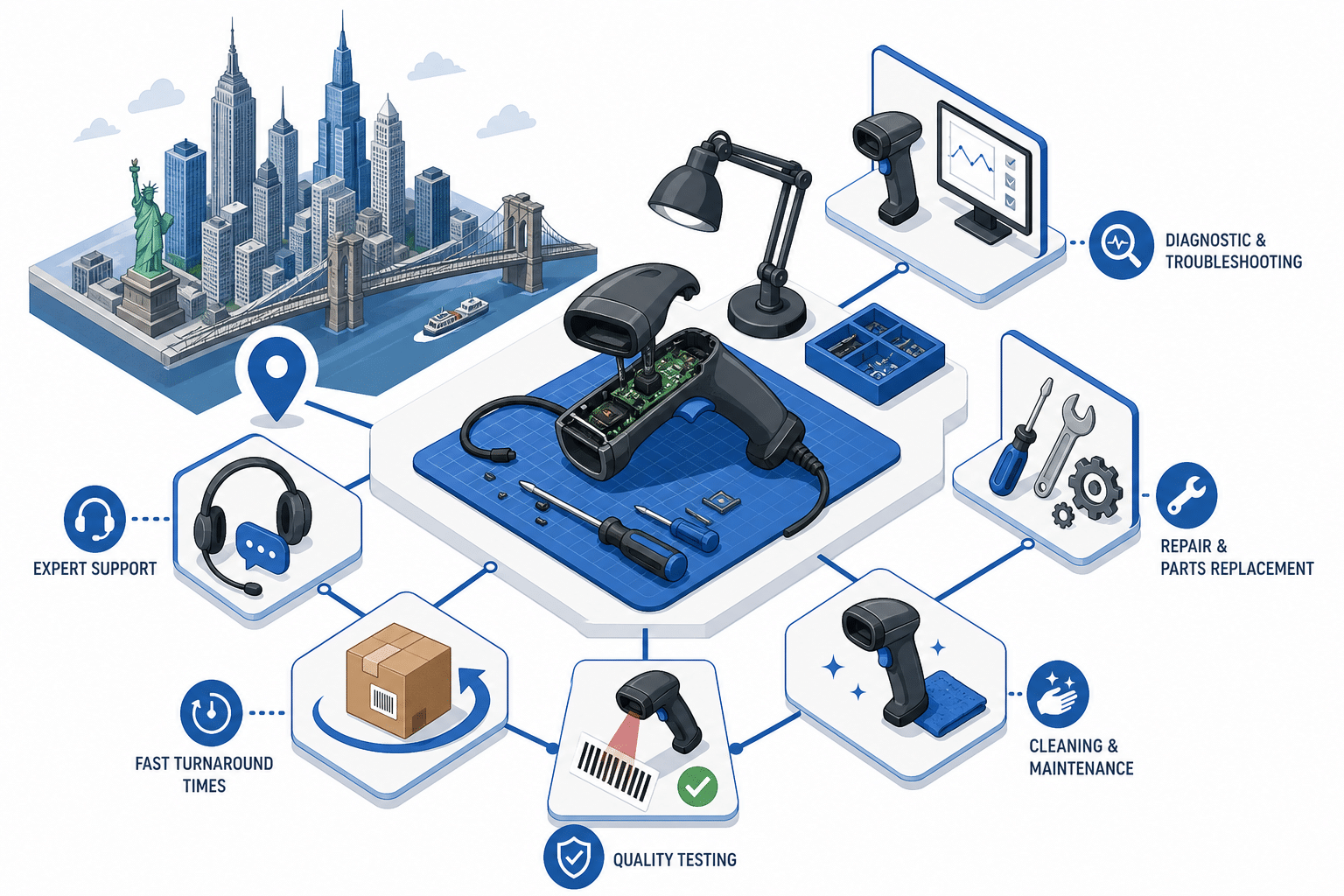
Barcode Scanner Repair: Key Stats for New York Businesses
Sources: industry analyst estimates, VDC Research barcode scanner market reports, and ABC internal service data. Individual results vary by environment and hardware platform.
The Most Common Barcode Scanner Failures We See in New York
Cracked or fogged scan windows are the single most frequent hardware fault we encounter, especially on handheld units used in warehouse or loading-dock environments. The fix is a window replacement, but the underlying cause is almost always the absence of a protective holster or regular inspection schedule.
Connector and cable failures rank second. USB, RS-232, and tethered Ethernet cables flex thousands of times per shift, and the strain relief point at the handle junction is the first place a break occurs.
Replacing the cable assembly is a straightforward bench repair when parts are in stock, but delays happen when non-standard connector variants are involved.
Trigger failures and keypad wear come up frequently on units that log more than 50,000 scans per month. These are mechanical wear items with defined life cycles, and replacing them on a scheduled basis during preventive maintenance visits is far cheaper than an emergency swap during a shift.
Decoder and firmware errors are less visible but equally disruptive. A scanner that reads some labels and rejects others, or that pairs inconsistently with a Bluetooth base station, often has a firmware version mismatch or a corrupted configuration file rather than a hardware fault.
Bench-level diagnostics with the manufacturer’s service tool resolves most of these cases in under an hour.
What a Barcode Scanner Maintenance Plan Actually Includes
A maintenance plan is not just a service call agreement. It is a structured schedule of cleaning, calibration, firmware updates, and physical inspection that keeps failure rates predictable and low.
Quarterly cleaning cycles matter most in New York environments where scanners are exposed to dust, grease, or food particles. A contaminated scan window or a clogged ventilation port on a corded base unit degrades read accuracy before any visible damage appears.
Firmware update management is a step many businesses skip because it requires coordinating a brief downtime window. Skipping it creates decoder incompatibility problems when label formats change or when a new barcode symbology is introduced across a supply chain partner’s shipping labels.
Annual physical inspection rounds out the plan. A technician checks cable strain relief, trigger spring tension, battery health on cordless units, and cradle contact integrity.
Catching a battery that holds only 60 percent capacity before it causes a mid-shift dropout is far less disruptive than replacing it reactively.

Barcode Scanner Brands and Models We Service in New York
ABC services Zebra, Honeywell, Datalogic, Cognex, Unitech, and Socket Mobile scanners, covering both handheld and presentation-style units as well as fixed industrial readers used in manufacturing lines.
Zebra DS and LS series scanners are among the most widely deployed in New York retail and logistics operations, and we carry the most common replacement windows, trigger assemblies, and cable sets for those lines on our service vehicles. Honeywell Xenon and Voyager series units are a close second in local deployment density.
For fixed industrial readers, including in-counter grocery scanners and conveyor-mounted scan tunnels, repairs typically require bench work rather than on-site swaps. We offer pickup and return logistics within the five boroughs to minimize the time a line is down waiting for hardware.
If your scanner model is not on our standard list, bring us the part number and symptom. We can often source components through our distributor network within one to two business days and will tell you up front if a unit is more economically replaced than repaired.
How to Choose a Barcode Scanner Repair Partner in New York
The first question to ask any repair vendor is whether they carry parts for your specific model. A vendor who orders parts after diagnosing the fault adds two to five business days to every repair.
A vendor with stocked inventory closes most jobs on the first visit.
Ask about technician certification. Zebra OneCare and Honeywell service authorization programs require technicians to pass model-specific training, and authorized shops can submit warranty claims on your behalf rather than routing you through manufacturer call centers.
Response time commitments should be in writing, not verbal. A service level agreement that specifies a four-hour or same-business-day response window gives you a benchmark to hold the vendor to.
Vague promises of ‘fast service’ do not help when a scanner line is down during a peak shipping week.
Finally, ask for references from other New York businesses in your industry. A vendor who supports healthcare barcode scanning understands patient safety compliance requirements that a vendor focused on retail would not.
Sector-specific experience shortens the diagnostic conversation and reduces the risk of an incomplete repair.
New York Industry Scenarios Where Scanner Downtime Hurts Most
In a Bronx or Queens food distribution warehouse, a downed scan station at the inbound dock means pallets are accepted without verified lot traceability, creating a food safety compliance gap that is expensive to unwind retroactively.
In a Manhattan hospital pharmacy, a scanner that misreads a medication barcode or drops connection mid-verification triggers a mandatory manual double-check process that can add 10 to 15 minutes per medication administration cycle across an entire nursing floor.
In a Brooklyn retail store during a holiday sales peak, a failed point-of-sale scanner creates line backups that drive customers to walk out. A 30-minute scanner outage during peak hours can cost a mid-size store hundreds of dollars in abandoned transactions.
In a Staten Island or Long Island City manufacturing plant, a conveyor-mounted scanner that starts producing read errors stops the line because upstream inventory counts no longer reconcile. Preventive maintenance on fixed readers is the most cost-effective way to protect those operations.
Frequently Asked Questions
How quickly can you respond to a barcode scanner repair call in New York?
For service contract clients in New York City, our standard response target is four hours from call receipt to technician on-site. For break-fix calls placed before 1 p.m., we target same business day dispatch and carry the most common parts for Zebra, Honeywell, and Datalogic units on our service vehicles.
Is it worth repairing an older barcode scanner or should we replace it?
The general rule is that if the repair cost exceeds 60 percent of the current replacement price for a comparable unit, replacement is the better financial choice. We give you a written repair estimate before any work begins, so you can make that comparison with real numbers rather than guesses.
Do you offer loaner scanners while a unit is being repaired?
Yes, for clients on a maintenance contract we maintain a loaner pool of common handheld models to keep your operation running during bench repairs. Loaner availability for break-fix clients depends on inventory at the time of the service call, so asking about it when you place the call is the fastest way to get one reserved.
Can you service barcode scanners that are still under manufacturer warranty?
We are authorized service partners for several major scanner brands, which means repairs we perform can be submitted through the manufacturer’s warranty process when applicable. For brands where we are not authorized, we can diagnose the unit and help you navigate the manufacturer’s warranty claim process rather than voiding coverage through unauthorized repair.
What does a preventive maintenance visit for barcode scanners actually include?
A standard preventive maintenance visit covers physical cleaning of the scan window and housing, cable and connector inspection, trigger and keypad wear assessment, firmware version verification, and a basic read-accuracy test against a certified barcode test card. We document findings and flag any components approaching end of rated life so you can schedule replacements before a failure occurs.